
Loitering munition/reconnaissance UAV
| Wingspan | 2,47 m |
| Length | 1,56 m |
| MTOW (gross takeoff weight) | 25 kg |
| Launch type | Catapult |
| Engine type | Electric |
| Maximum Range | 50 km |
| Cruise Speed | 120 km/h |
| Ceiling Altitude | 3500 m |
| Endurance | 150 min |
| Attack Guidance | GNSS, Visual Navigation optical guidance, automatic aiming using AI |
| Payload | 5 kg |
- Equipped with modern optoelectronic equipment, including infrared and thermal imaging cameras
- The autopilot component manages altitude and directional stability
- Automated guidance and targeting systems using AI
- The ability to transmit video and data in real time, which ensures prompt decision-making on the battlefield.
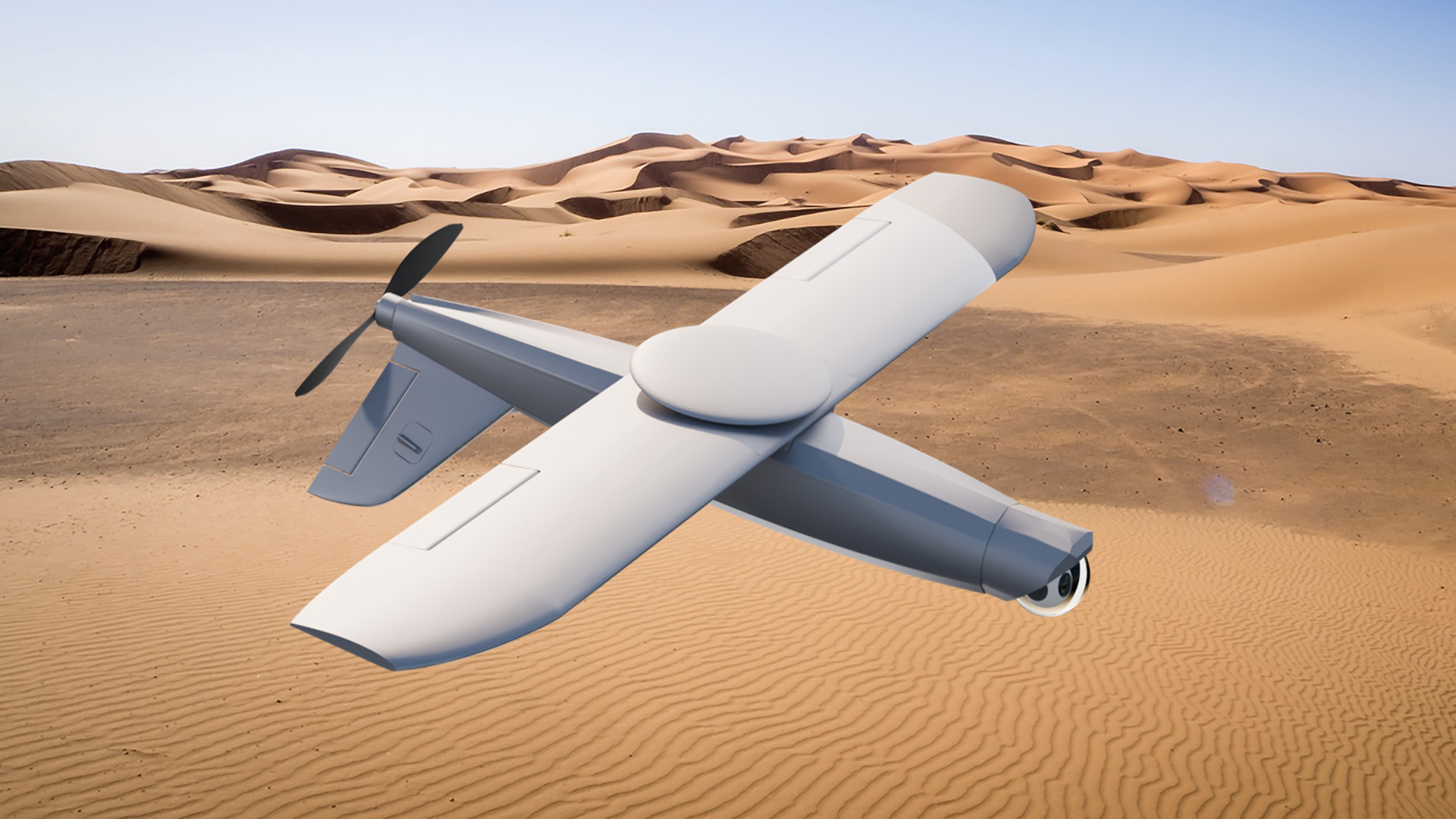
The NSR13Block-AI DABBUR is fixed-wing combat UAV designed for high-performance precision strikes. With a wingspan of 2,47 meters, it has a range of up to 50 km, making it suitable for effective missions.
Operating at a cruising speed of 120 km/h, this UAV is equipped with advanced AI for automatic target detection and navigation. Its AI-driven guidance system enables real-time adjustments and precise targeting, enhancing mission efficiency and minimizing operator involvement.
This UAV combines cutting-edge technology and durable construction, providing a reliable solution for tactical and strategic military operations.
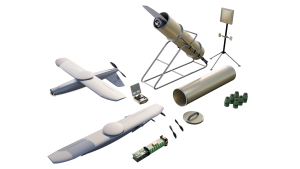
The primary structure, or airframe, crafted from lightweight composite materials, provides the essential aerodynamic design that allows for high endurance and stability during long missions. Central to the UAV’s operational capabilities is the avionics suite, which integrates navigation, communication, and sensor systems. The navigation system utilizes both GPS and an inertial navigation system (INS) for accurate geolocation, even in GPS-denied environments. The autopilot component manages altitude and directional stability, allowing for autonomous flight paths with minimal human intervention. The mission control unit connects all avionics components, facilitating seamless data exchange between systems for synchronized operation and mission execution. The guidance and targeting system, powered by an AI module, processes data from the onboard sensor array, which includes optical, infrared, and radar sensors. These sensors continuously scan the environment, feeding real-time data into the AI system to support autonomous target acquisition, threat detection, and target prioritization. This AI-driven system enables automatic engagement of targets within the mission scope, minimizing operator workload and maximizing strike precision. A secure data link ensures continuous communication with the ground control station, relaying mission updates, status, and sensory feedback.